What Would Change if Ethics came First?
4 min read
A while ago, whilst doing my usual weekly shop, I found myself standing in one of the aisles staring at two versions of the same product.
On the front of the first package, in big bold letters, was the word "Ethical".
And on the front of the other one, the words "Responsibly sourced."
Both had calming colours. Both of them looked like they wanted me to feel proud of myself.
I stood there thinking, "Surely.. one of you is lying… but to be honest I don’t currently have the emotional energy to investigate which."
And in that moment I realised something absurd: we’ve built entire systems where ethical responsibility falls onto tired people standing under fluorescent lights, squinting at packaging, hoping to make the “least bad” choice before dinner.
We've gotten very good at redesigning the aesthetics of harm.
And for some reason, we're much less interested in questioning why harm is built into the system to begin with.
But if these systems were designed - and they were - then they can, at least in theory, be designed differently.
So I wanted to try something. A kind of thought experiment. Not a fantasy. Just a values-first question:
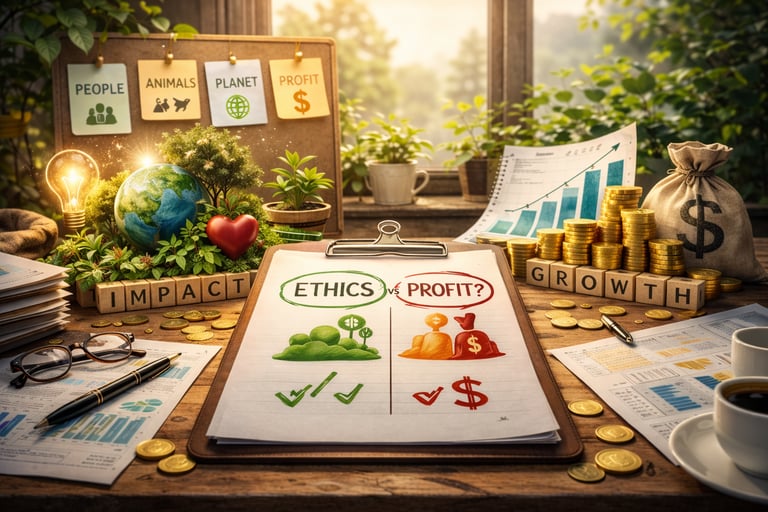
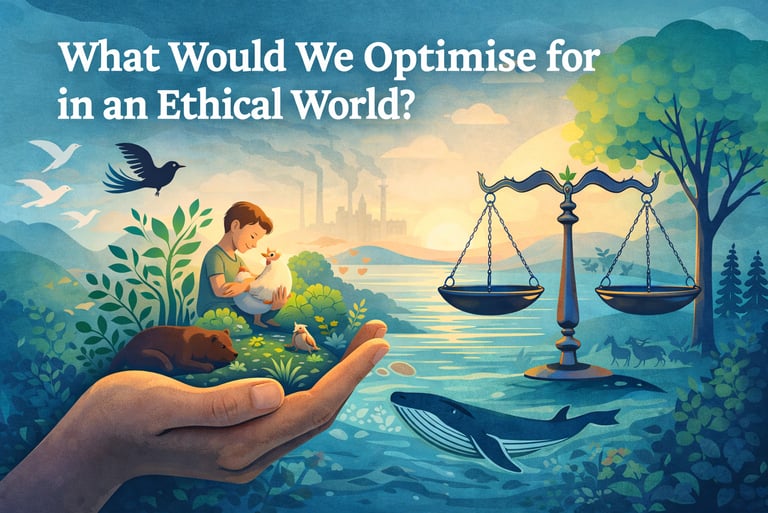
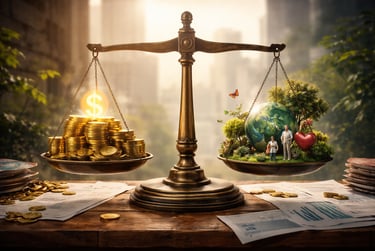
What would the world look like if we built it around minimizing harm instead of maximising profit?
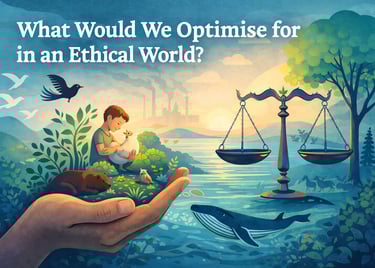
Let’s clear the board
Imagine we’re starting from scratch.
Same humans, though. Let’s be realistic. Same contradictions. Same capacity for generosity and selfishness, compassion and apathy, brilliance and truly baffling decision-making. There's been no moral glow-up montage. No sudden 'collective enlightenment'.
The only thing we change is the goal that we optimize for.
Right now, our systems are astonishingly good at one thing: growth. More output. More speed. More efficiency. And when harm shows up - as it inevitably does - we treat it like it's background noise. Something to be managed, rebranded, or subtly pushed far enough away that we don’t have to look at it too closely.
But what if we paused earlier in the process?
What if, instead of us asking “How much can we produce?” or “How cheaply can we do this?”, we asked a different question entirely:
Who does this affect - and how badly?
It’s not a complicated question. But it is an inconvenient one. And inconvenient questions do have a habit of revealing things we’d rather not confront.
Designing from the edges inward
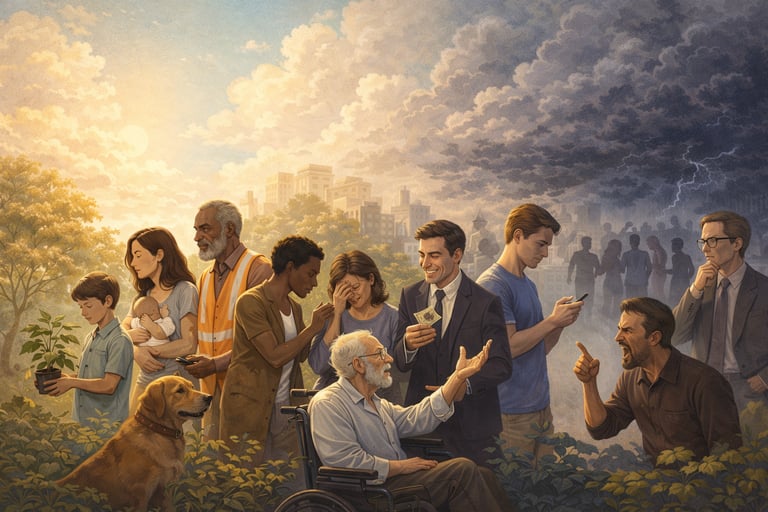
An ethical world wouldn’t begin with those already comfortable. It would start at the edges.
It would start with the people that are least able to opt out. With the animals who never get a vote. With the workers whose labour only becomes visible when it stops. With the children who will inherit the consequences of decisions made long before they had any voice at all.
When we design from the position of most vulnerable outward, a lot of our current “norms” start to look… odd. Even indefensible.
Food is a good example. In a harm-minimizing world, food systems wouldn’t be built primarily around maximizing output, chasing profit, or squeezing as much as possible out of land, animals, and workers. They’d be built around nourishment, ecological limits, and designing ways of feeding people that don’t require harm in the first place.
This doesn’t require moral perfection or some kind of universal agreement. It only requires honesty. About trade-offs. About costs. About who pays them.
The same logic applies to work. Productivity wouldn’t be mistaken for personal worth. Rest days wouldn’t need to be justified by exhaustion. Human limits wouldn’t be treated as design flaws - they’d be acknowledged, planned for, and respected.
None of this is wildly radical on paper. It only feels radical because we’ve normalized systems that never bothered to ask these questions at all.
Profit, escorted off the throne
This is usually where someone leans back and says, “So… you’re anti-business then?”
Not quite. I’m anti confusing profit with purpose .
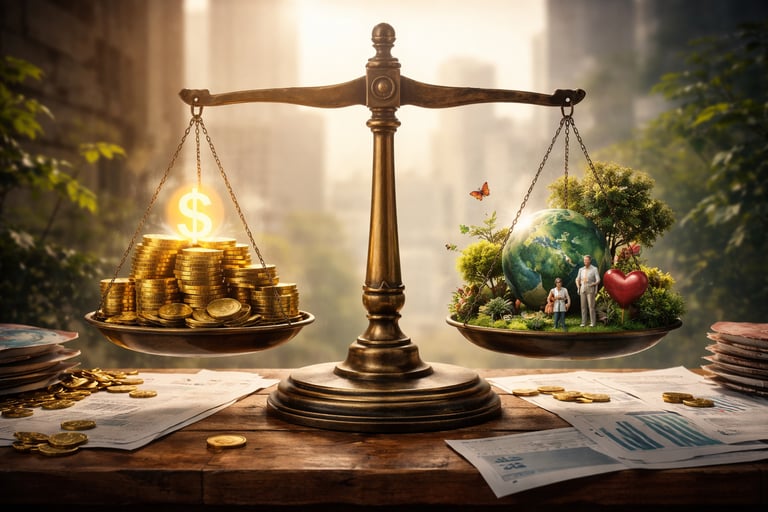
Profit is a tool - and a useful one. But it’s a terrible moral compass.
When profit becomes the primary measure of success, everything else becomes flexible. Whether it's wellbeing, ecosystems, dignity, or even life, if it’s distant enough from the end consumer. We rarely say it that plainly, of course. We frame it as efficiency, necessity, or “just how things work.”. But the logic doesn’t change.
In a values-first world, success would still involve growth - just not growth alone. Impact would matter. Harm would be counted. Innovation wouldn’t mean “faster and cheaper at any cost,” but “better, with fewer casualties.”
The interesting thing is that we already know how to do this. We just don’t apply it consistently, or at scale. Ethics gets treated like a nice optional feature instead of a design requirement.
When harm becomes expensive, inconvenient, or socially unacceptable, behaviour starts to change. Not because people suddenly become saints - but because these systems stop rewarding the worst outcomes.
Why imagining this isn’t naive — it’s necessary
There’s this idea that imagining a more ethical world is indulgent - something you do when you’re "avoiding reality". I don’t buy that.
Imagination is where values get tested before they ever hit reality. It’s where we work out what we’d prioritise if we were being honest, before compromise and complacency sands everything down.
By asking what an ethical world might look like, we're not trying to predicting the future. These kinds of questions help us expose the ideas that we’ve inherited - and decide which ones we’re willing to keep.
Because once you notice that these systems are designed, you can’t unsee it.
And once you accept that they can be redesigned - imperfectly, gradually, unevenly - the question stops being “Is this realistic?” and becomes something far more uncomfortable:
What are we still willing to tolerate?
Maybe an ethical world doesn’t begin with grand solutions at all - just with the refusal to keep calling preventable harm “normal.”
That might not sound revolutionary.
But it’s how real change usually starts.